Blog
What Is an AI Photo Booth? The Complete Guide (2026)
What Is an AI Photo Booth? The Complete Guide (2026)
Everything you need to know about AI photo booths: how they work, what they cost, real case studies with results, and how to choose the right one for your event or brand activation.

AI photo booths have rapidly moved from novelty to must-have at corporate events, brand activations, and tradeshows worldwide. But what exactly are they, how do they work, and are they worth the investment?
This guide covers everything you need to know - from the technology behind AI photo booths to real deployment data from over 400 activations across 20+ countries. Whether you're an event planner evaluating options, a brand manager building an activation brief, or a marketing team looking to generate shareable content at scale, this is the definitive resource.
What Is an AI Photo Booth?
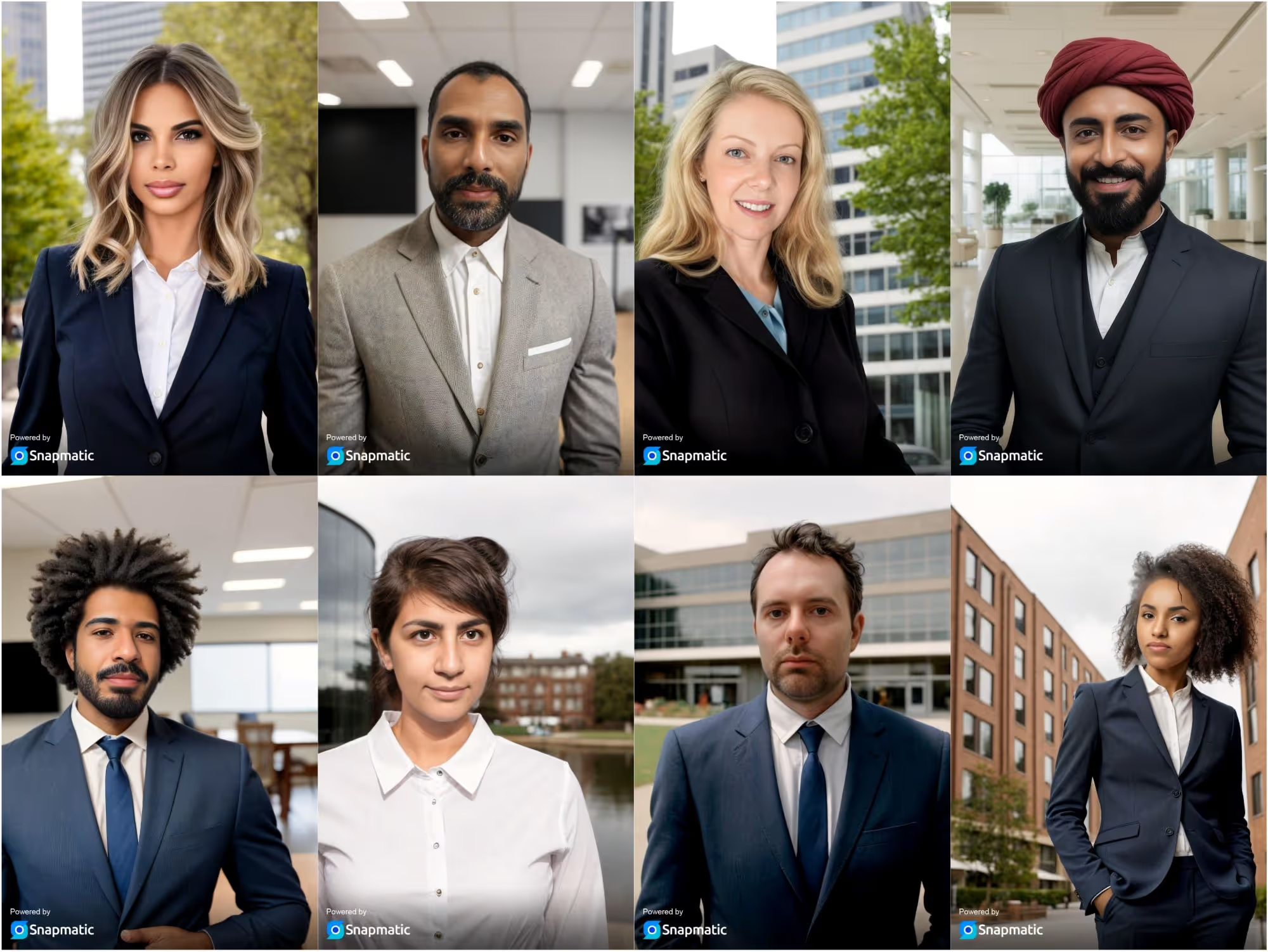
An AI photo booth is an interactive experience that uses artificial intelligence to transform a guest's photograph into a stylised, branded image in real time. Unlike traditional photo booths that apply simple filters or overlays, AI photo booths use generative AI to completely reimagine the subject - placing them in new environments, outfits, and artistic styles while preserving their likeness.
The result is a hyper-personalised image that guests genuinely want to share on social media, turning every participant into a brand ambassador. A single AI photo booth can process 60 to 80 guests per hour, generating images in approximately 20 to 30 seconds each.
AI Photo Booth vs Traditional Photo Booth
Understanding the difference matters when you're choosing the right solution for an event. Here's how they compare across the key factors:
Output: A traditional booth gives you standard photos with filters, frames, or overlays. An AI photo booth produces fully AI-generated images with complete scene transformation.
Personalisation: Traditional booths are limited to preset templates. AI booths create bespoke themes tailored to your brand identity and campaign creative.
Shareability: Traditional booth photos generate moderate sharing. AI-generated images are unique and genuinely surprising - driving significantly higher social sharing and organic reach.
Brand Integration: Traditional booths offer logo overlays and branded frames. AI booths weave environments, costumes, props, and brand elements directly into the generated imagery.
Setup Options: Traditional booths require a fixed unit. AI booths offer kiosk, iPad, or browser-based BYOD (bring your own device) deployment.
Data & Analytics: Traditional booths provide a basic photo count. AI booths include real-time engagement tracking, social share analytics, and optional lead capture.
Scalability: Traditional booths mean one booth, one queue. AI booths with BYOD allow unlimited concurrent guests using their own devices.
The key differentiator is the output. A traditional photo booth gives you a photo of yourself with a border. An AI photo booth gives you an image of yourself as a Viking warrior, a Formula 1 driver, or a character from a blockbuster film - and that's the kind of content people share.
How Does an AI Photo Booth Work?
The process is straightforward for guests, but there's sophisticated technology working behind the scenes.
The Guest Experience
- Capture - The guest visits the booth and has their photo taken, either at a staffed kiosk, a self-service iPad, or via their own device using a QR code.
- Transform - The AI analyses the guest's likeness and generates a new image based on the custom theme. This takes approximately 20 to 30 seconds.
- Preview - The guest sees their transformed image on screen.
- Share - They share it directly to social media, download via QR code, or receive it by email. At select activations, physical prints are also available on-site.
The Technology
Modern AI photo booths use generative AI models to create images. The system is trained or configured with a specific visual theme - this could be anything from a Viking warrior aesthetic to a branded sports jersey to a steampunk universe. When a guest's photo is captured, the AI preserves their facial features and likeness while generating everything else: background, clothing, lighting, and artistic style.
The best systems handle challenges that simpler AI tools struggle with, including consistent brand element placement (logos, uniforms, product integration), group photos with multiple subjects, and maintaining quality at high throughput volumes.
Deployment Options
AI photo booths aren't limited to a single format. The three main deployment types offer flexibility for different event scenarios:
- Staffed Kiosk - A fully managed booth with an on-site technician. Best for premium activations, VIP events, and situations where you want a polished, guided experience. This is the most popular option for brand activations and tradeshows.
- Self service Kiosk - A self-service setup using an iPad on a stand. Lower staffing requirements, ideal for longer-running installations or permanent retail deployments. The Roshen Retail activation in Bucharest used this approach for a permanent in-store steampunk-themed AI photo mirror that engaged over 13,000 participants in its first three months.
- Web-Based BYOD - Guests scan a QR code and use their own device's camera. This eliminates queues entirely and allows unlimited concurrent participants. TechnologyOne used this approach across their four-city Showcase Roadshow in Australia and New Zealand, where attendees chose from nine themed scenarios on their own phones.
What Events Are AI Photo Booths Used For?
AI photo booths work across a wide range of event types. Based on over 400 activations delivered worldwide, the most common use cases include:
Brand Activations
The most popular application. Brands create custom AI themes that align with campaign creative, turning event attendees into shareable brand content. INEOS ran a month-long activation at Battersea Power Station in London where visitors could see themselves in mountain, sea, forest, or snow environments alongside the Grenadier vehicle — connecting the brand's adventurous positioning with a personalised experience guests wanted to share.
Tradeshows and Conferences
AI photo booths consistently draw the highest booth traffic at tradeshows. At Korean Blockchain Week 2025, a single Primatix booth processed 895 guests in a single day — the highest volume ever recorded — with sustained queue demand throughout. The DogeOS team reported that the booth helped them "stand out from the rest" in a crowded exhibition hall.
Film and Entertainment Launches
NBCUniversal and DreamWorks partnered with Allied Global Marketing to deploy AI photo booths across seven countries for the How to Train Your Dragon live-action film launch. The campaign generated 4,890 participant portraits across Singapore, Thailand, Indonesia, India, Vietnam, Malaysia, and Belgium,.
Corporate Events and Internal Engagement
Enterprise clients including Dell, SAP, AWS, and Rolls-Royce have used AI photo booths at internal conferences and customer events. A confidential US tech company scaled from an initial eight-city roadshow to a full 14-city nationwide tour across Q1 and Q2 2025, covering cities from Toronto to San Antonio - going from brief to kickoff in under 24 hours.
Motorsport and Sports Hospitality
In the F1 Paddock Club, AI photo booths generated personalised racing driver portraits for VIP hospitality guests over multiple race weekends from 2023 to 2025. The activation created 1,968 unique AI portraits from 337 participants, with the agency partner Velocity noting: "We've never had an interactive as engaging as this. It created a lot of conversations and guests loved the experience."
Retail Installations
AI photo booths aren't limited to one-off events. Permanent or semi-permanent installations in retail environments create ongoing customer engagement. The Roshen Retail deployment in Bucharest ran a steampunk-themed AI photo mirror with bilingual support (Romanian and English), QR code sharing, and on-site printing - engaging over 13,000 participants in three months.
Pre-Event and Virtual Campaigns
AI photo experiences can run entirely online. ISPIM (International Society for Professional Innovation Management) deployed a virtual AI Viking avatar tool months before their Bergen conference - building social momentum with the hashtag #BeInBergen before the event even started. The Canadian Association of Gift Planners ran a 12 month online campaign 'Will Power' featuring an AI portrait generator to drive a national movement encouraging Canadians to leave charitable gifts in their wills.
How Much Does an AI Photo Booth Cost?
AI photo booth pricing varies based on several factors:
- Event duration - A half-day activation costs less than a multi-week installation
- Deployment type - Staffed kiosks require crew; BYOD is the most cost-efficient
- Customisation - A bespoke AI theme developed from scratch costs more than adapting an existing template
- Location - International deployments involve travel, logistics, and local crew sourcing
- Volume - Multi-event packages and roadshows offer better per-event value
Pricing is typically quoted per event and includes the booth hardware, AI processing, custom theme development, on-site technical support, a branded event gallery, and real-time analytics tracking engagement and social shares.
For enterprise activations with major brands, expect investment levels that reflect the technology, staffing, and creative development involved. The ROI calculation should factor in the volume of branded, shareable content generated - every guest who shares their AI image extends your campaign reach organically, at no additional cost.
Contact your provider directly for a custom quote based on your specific event requirements.
What to Look for When Choosing an AI Photo Booth Provider
Not all AI photo booths are equal. Here are the key factors to evaluate:
Image Quality and Brand Integration
The AI output should look genuinely impressive, not gimmicky. Ask to see examples of brand-specific theme development. The best providers can integrate specific brand elements - logos, uniforms, products, colour palettes - directly into the AI-generated imagery rather than simply overlaying them.
Processing Speed and Capacity
Ask about throughput. At high-traffic events, a system that takes two minutes per image will create long queues and frustrated guests. The benchmark for photo-based AI is 20 to 30 seconds per image, enabling 60 to 80 guests per hour from a single booth.
Data Privacy and GDPR Compliance
This is non-negotiable for enterprise clients. Ensure the provider offers configurable image retention policies, anonymous storage, GDPR-compliant data handling, and clear privacy policies for each project. Guest data should be handled securely, with retention periods you control.
Deployment Flexibility
Can the provider support your specific venue and format? Options should include staffed kiosks, self-service iPads, and web-based BYOD experiences. For international deployments, ask about local crew availability and logistics capability.
Analytics and Reporting
Real-time dashboards showing guest engagement, social shares, and gallery views help you demonstrate ROI to stakeholders. The best providers offer post-event reporting that quantifies the activation's impact.
Track Record
Ask for case studies with real numbers. How many activations have they delivered? In how many countries? For which clients? A provider with hundreds of deployments across multiple continents has encountered and solved problems that a newer entrant hasn't yet faced.
The Future of AI Photo Booths
AI photo booth technology is evolving rapidly. Several trends are shaping where the industry is heading:
AI Video Booths - The next evolution. Rather than a static image, guests receive a short AI-generated video clip with branded motion graphics and transitions. This format is already being deployed at major tradeshows - Sharegate debuted an AI Video Booth at Microsoft Ignite 2025 in San Francisco, producing 10-second looping videos with a live LED gallery displaying the latest results.
AI Trading Cards - Collectible, personalised trading cards generated by AI and printed on-site. Guests receive a physical card featuring their AI-generated portrait with custom stats and branding. This format works particularly well at fan zones and exhibitions - Lenovo ran FIFA-themed AI Trading Cards at a London corporate event, and Visit Pittsburgh deployed them at IMEX Las Vegas.
Higher Quality, Faster Processing - Each generation of AI models produces more photorealistic output at faster speeds. What took 60 seconds two years ago now takes under 30, and the visual quality continues to improve with each iteration.
Hybrid Digital-Physical Experiences - Combining on-site AI generation with physical printing, Physical trading cards, and digital gallery sharing creates multi-touchpoint experiences that extend engagement beyond the event itself.
Explore more of what we do: the AI photo booth, AI video booth, and AI trading cards, or a fully custom AI theme built around your brand. Browse the gallery of real outputs, see the results in our case studies, or get in touch to talk through an event.
Key Takeaways
- An AI photo booth transforms guest photos into fully AI-generated branded images in near real time - not just filters or overlays, but complete scene reimagination.
- Three deployment options (staffed kiosk, iPad, web-based BYOD) make AI photo booths adaptable to any event format, from intimate VIP hospitality to 14-city roadshows.
- Throughput of 60 to 80 guests per hour with 20 to 30 second processing, scaling to higher volume concurrent users via BYOD.
- Proven at scale across 400+ activations in 20+ countries for clients including Dell, SAP, AWS, Rolls-Royce, NBCUniversal, and Lenovo.
- Single-day record of 895 guests processed through one booth at Korean Blockchain Week 2025.
- Every guest becomes a brand ambassador - the shareable, hyper-personalised output drives organic social reach that extends your activation far beyond the event itself.
Primatix delivers AI photo booth, AI video booth, and AI trading card experiences for brand activations, corporate events, and tradeshows across the UK and worldwide. Request a demo or try it for free.


Primatix creates highly engaging AI-powered photo & video experiences. Increase your event engagement and brand awareness with shareable, user-generated content that gets people talking!

© Primatix 2026. All Rights Reserved