Blog
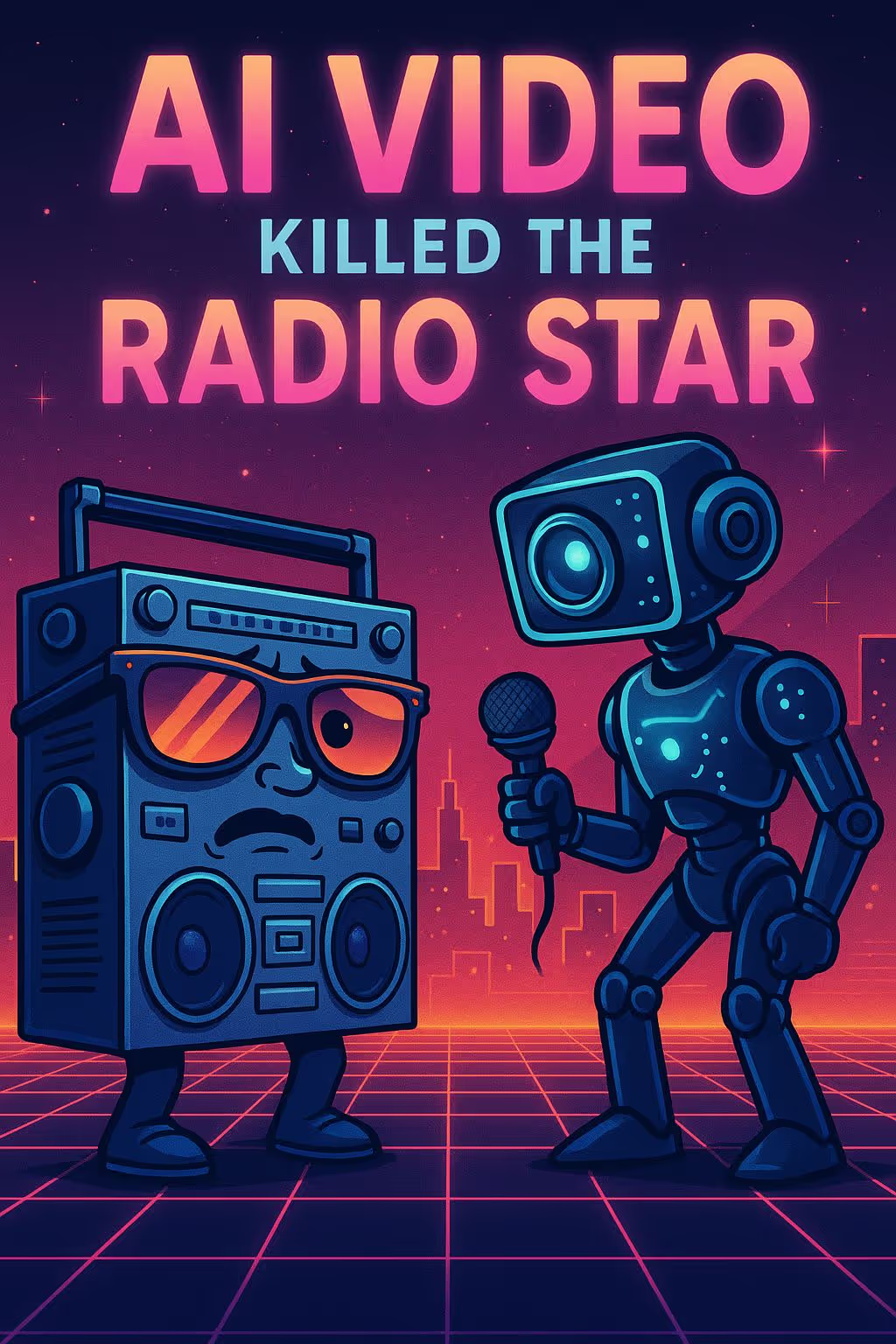
AI Video Booths: From Sceptic to Believer — Why We Finally Built One
AI Video Booths: From Sceptic to Believer — Why We Finally Built One
We were sceptical about AI video booths. Then corporate clients started asking for motion content. Here's what happened when we debuted at Microsoft Ignite with Sharegate.
AI Video Booths: From Sceptic to Believer — Why We Finally Built One
We'll be honest: we were sceptical about AI video.
Not because the technology wasn't impressive - but because our core clients, especially in the corporate and B2B space, didn't seem to want it. The focus was always on high-quality stills, instant delivery, and frictionless user experience. AI video booths felt more like a festival gimmick than a real engagement tool for brand activations.
We watched other providers rush to market with low-resolution outputs, clunky rendering times, and results that made brands wince rather than share. We decided to wait.
That turned out to be the right call. Because when we finally launched our AI Video Booth in Q3 2025, we launched it into the most demanding environment imaginable: a major tech conference, for a SaaS brand, in front of thousands of enterprise buyers. And it worked.
What Changed Our Mind
In early 2025, a pattern started emerging in our client conversations that we couldn't ignore.
Corporate clients - especially in finance, technology, and professional services - began asking not just for images, but for motion content. Not TikTok trends. Not deepfake celebrity clips. They wanted short, polished AI-generated video loops with the guest's likeness that looked like they were always meant to be part of the brand story.
The shift made sense when we looked at the platforms. LinkedIn was pushing video hard. Instagram Reels had overtaken static posts in engagement. Even WhatsApp status updates favoured motion. Corporate guests were just as happy to share a slick five-second clip as they were a headshot - and the engagement numbers on video content were consistently higher.
The market wasn't asking for a gimmick. It was asking for the next format. And we needed to deliver it at the same quality level our clients expected from our AI photo booth.
How an AI Video Booth Actually Works
The workflow is deliberately similar to our photo booth experience, because adding complexity for guests is the fastest way to kill engagement at an event.
Here's the process:
- Capture — A guest has their portrait taken at an iPad-based kiosk, exactly like our photo booth setup.
- AI Generation — The system generates a short branded video loop using the guest's likeness. This takes approximately two minutes — longer than our 20-30 second photo generation, but the output is fundamentally different.
- Delivery — The guest enters their email and receives the finished video within five minutes. While they wait, a live LED gallery at the booth displays the latest results, creating a crowd-drawing visual showcase.
- Sharing — The video is optimised for social platforms and can be shared directly from the email or downloaded via QR code.
Each video is a 10-second looping clip with branded motion graphics, custom transitions, and the guest's AI-transformed portrait animated within the brand's visual identity. These aren't filters or overlays. The AI generates a complete scene with movement, lighting shifts, and cinematic quality.
Crucially, the video booth runs within the same Primatix pipeline as our photo experience. Same hardware, same staff, same setup. No extra equipment, no separate workflow, no additional complexity for the client or the on-site crew.
The Microsoft Ignite Debut
Our first AI Video Booth deployment wasn't a soft launch at a friendly client's internal event. It was Microsoft Ignite 2025, at the Moscone Center in San Francisco, for Sharegate (operated by Workleap) — one of the most high-profile SaaS tradeshows in the calendar.
The brief was ambitious: create an AI experience themed around "What's your Microsoft 365 superpower?" that would draw traffic to Sharegate's booth and generate shareable branded content for LinkedIn.
What We Deployed
- iPad-based kiosk capturing attendee portraits
- AI-generated 10-second looping videos with branded motion graphics
- QR code scan-to-mobile sharing
- Live LED gallery displaying the latest results in real time
What We Learned
Microsoft Ignite was the proof point we needed. The LED gallery created a visual magnet effect - attendees walking past could see the latest AI-generated videos cycling on screen, which drew them to the booth without any hawking or pitch. The content sold itself.
The video format drove significantly more LinkedIn sharing than photo-only activations at comparable events. When someone receives a cinematic 10-second loop of themselves reimagined as a Microsoft 365 superhero, the impulse to post it is immediate. That's earned media for Sharegate, delivered organically by the people they most want to reach: enterprise tech buyers.
This deployment also validated our technical pipeline under real-world conditions. Processing AI video at scale in a conference environment - with unpredictable Wi-Fi, high throughput demands, and zero tolerance for downtime - is a fundamentally different challenge to generating still images. The two-minute processing time held steady throughout!
AI Video vs AI Photo: When to Use Which
AI video doesn't replace AI photo. They serve different purposes and work best in different contexts. After deploying both formats across hundreds of activations, here's how we advise clients:
Choose AI Photo when:
- Throughput is the priority - 60-80 guests per hour vs approximately 30 with video
- You need instant gratification : 20-30 seconds vs 2 minutes
- The activation is high-footfall with constant queuing (tradeshows, fan zones)
- You want physical printing on-site (photos print cleanly; video needs a screen)
- Budget is tighter - photo is the more cost-effective format
Choose AI Video when:
- Social sharing and LinkedIn reach are the primary KPI
- The brand aesthetic is cinematic or motion-oriented
- You want a visual showcase element (LED gallery, event screens)
- The audience is smaller but higher-value (VIP hospitality, executive events)
- You want to stand out - AI video is still rare enough to genuinely surprise
Choose both when:
- You're running a multi-day event and want to offer variety
- Different zones serve different audiences (e.g., main floor photo booth + VIP lounge video experience)
- The client wants maximum content diversity from a single activation
The operational advantage is that both run through the same Primatix pipeline. Switching between photo and video output doesn't require different hardware, different staff, or a different setup. It's a configuration change, not a rebuild.
Why We Were Right to Wait
We're glad we didn't rush into video when the format wasn't mature. Through 2023 and 2024, we watched AI video providers struggle with problems that would have been unacceptable to our enterprise clients: low-resolution output, inconsistent brand rendering, processing times measured in minutes rather than seconds, and results that looked obviously artificial.
By waiting until the underlying models caught up with our quality standards, we launched a product that was ready for prime time from day one. No beta testing on paying clients. No "it'll get better" caveats. The Sharegate deployment at Microsoft Ignite was our first video activation, and it ran at the standard our clients expect from every Primatix deployment.
That patience also meant we could integrate video into our existing pipeline rather than building a separate product. For clients, that means one vendor, one setup, one team - whether they want photos, videos, trading cards, or all three from the same booth.
What's Next for AI Video
The video format is evolving fast. Processing times are dropping with each model generation. Resolution and cinematic quality are improving. And client demand is accelerating — after Microsoft Ignite, we've had more video enquiries in three months than in the entire previous year.
We're seeing particular interest from:
- SaaS and tech companies — LinkedIn is their primary channel, and video outperforms static content on the platform
- Automotive brands — motion naturally complements vehicle launches and experiential activations
- Entertainment and media — film and TV launches benefit from cinematic AI treatment
- Sports hospitality — VIP guests expect premium, differentiated experiences
The next milestone is bringing processing time below 60 seconds while maintaining cinematic quality. When that happens, the throughput gap between photo and video closes significantly — and video becomes viable for high-traffic environments that currently favour photo-only deployments.
See It for Yourself
The best way to understand AI video is to experience it. We can generate a personalised sample using your brand assets in a live demo call.
If you're planning a tradeshow, corporate event, or brand activation and want to understand whether AI video, AI photo, or a combination of both is the right fit, get in touch. Or explore our AI Video Booth product page for technical specifications and deployment options.


Primatix creates highly engaging AI-powered photo & video experiences. Increase your event engagement and brand awareness with shareable, user-generated content that gets people talking!
© Primatix 2026. All Rights Reserved